

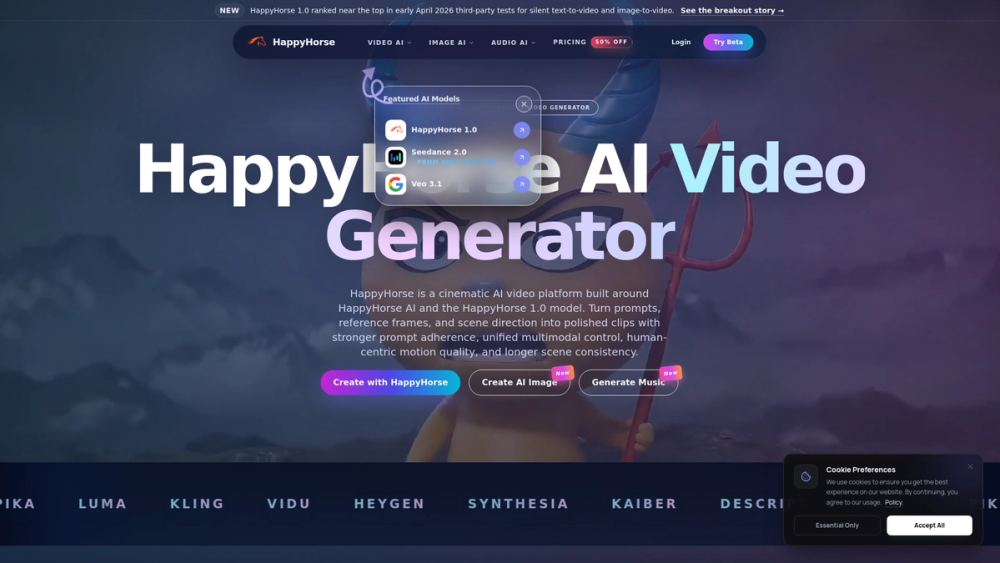
HappyHorse — Technical Introduction
HappyHorse is a cinematic AI video platform centered on the HappyHorse AI engine and the HappyHorse 1.0 model. It focuses on unified multimodal generation (text, video, audio) and is optimized for human-centric motion, prompt fidelity, and image-guided scene control.
Key features
- Text-to-video and image-to-video generation with reference-frame guidance and storyboard control.
- Unified single-stream multimodal architecture (public notes cite a 40‑layer single-stream Transformer) that models text, video, and audio tokens together for sound‑aware output.
- Low‑step inference (reported 8 denoising steps) and design choices reported without classifier‑free guidance (CFG) in some writeups.
- Strong prompt adherence and multilingual prompt support for cross‑language direction.
- Image guidance for facial performance, body motion, shot continuity, and improved lip‑sync alignment.
- Human‑centric motion and continuity intended for conversation scenes, ads, digital‑human clips, and multilingual promos.
- Starter/free tier credits for testing; paid tiers for higher throughput, longer scenes, and production capacity.
Technical notes
- Public writeups referenced by the site describe an architecture with ~40 Transformer layers and single‑stream self‑attention across modalities; full training recipe is not publicly released.
- The system emphasizes end‑to‑end multimodal consistency (timing, audio awareness) and inference speed via fewer denoising steps.
Primary use cases
- Marketing and ad creatives: short trailers, product demos, launch videos with controlled camera motion and actor continuity.
- Social videos and creator testing: fast iteration on concepts using prompts + reference frames.
- Digital humans and dialogue scenes: improved facial expression, lip‑sync, and body motion for character‑centric shots.
- Multilingual promos and training videos where prompt translation and timing matter.
Content safety & compliance
- The site states policies to block impersonation, non‑consensual content, misinformation, and requires rights for uploaded faces/voices/brand assets.
Target users
- Creative teams, agencies, ecommerce & marketing groups, educators, and in‑house studios needing controllable, production‑oriented AI video.


